Showing posts with label Coenagrionidae. Show all posts

Saturday, April 4, 2020

Coenagrionidae Aciagrion

Family Coenagrionidae

Aciagrion approximans approximans
(Selys 1876)
Elevation 80-800m
Abdomen Length 22-24mm

Another species from the Beeshajar Ramsar site and at Dipang Taal in Pokhara. Several wetland areas beside the road are accessible from the main track. The wetland was just beside a canal near one of the larger lakes. This is an attractive purplish-blue damselfly. Besides being found in Nepal, it is seen in parts of India.
Male


Aciagrion olympicum
Laidlaw, 1919
Elevation 1500m
Abdomen Length 32-34mm
It was seen in the Godavari wetland for a couple of months in 2014 and again in 2019. It is only recorded in Nepal, NE India, and Bhutan. The male is similar to the female but has blue on segments 8 to 10. The female body was not fully colored then but the blue markings on segments 8,9 and 10 were clear, and the thorax was tan and brown with brown-black markings on the surface of the abdomen. Later in July, the color is deeper seen from mid-April until July.
Female

Aciagrion pallidum
Selys, 1891
Elevation 800 to 1500m
Abdomen Length 31mm
The Pale Slender Dartlet has a ground-colored body that makes it hard to spot. The thorax has pale blue stripes and is very attractive up close. In Bees Hajar, it was next to a partially dried wetland. Also, it has been recorded at Lamjung, Bardia, and Syangja. It is usually found after the monsoon and through October. It is a regional species found in India, Bhutan, and Thailand.
Male
Female

Wednesday, April 1, 2020

Coenagrionidae Agriocnemis

Family Coengarionidae

Agriocnemis clauseni
Fraser 1922
Elevation 80-1000
Abdomen 20-22mm

A small attractive damselfly that I saw at Bees Hajar sitting on vegetation next to the canal. It is fairly common regionally. It is also located at Rupa Taal near Pokhara. It has two color forms for the female, one similar to a juvenile male and a red form.
Male

Female


Agriocnemis femina
(Brauer 1868)
Elevation of level to 1000m
Abdomen length 16-17mm

Very similar to A. pygmaea in size and color but the main differences are the size and shape of the anal appendages,
 a pruinosed thorax, and a darker abdomen. It is very common and widely distributed throughout Southeast Asia and Australasia. It is found primarily in grasslands near ponds and lakes. These photos are from the Parsa Reserve in the Terai area of southern Nepal.
Male

Female


Agriocnemis lacteola
Selys 1877
Elevation 150-800m
Abdomen 16-18mm

A lovely milky white damselfly that is found in wetland areas. It was found in Bis Hajar Taal and in the Haldi Bari forest wetland. The females are very attractive with a blue and black abdomen. About the same size as A. pygmaea but much easier to spot.
Male

Female


Agriocnemis pygmaea 
Rambur 1842
Elevation sea level to 1370m
Abdomen 16-17mm
Hard to detect due to its minuscule size and the way it drifts between blades of grass next to ponds, streams, and wetland areas. The ID is from the red tip of the abdomen and the green, tiny anal appendages, and the black and green thorax. A very common damselfly in Asia. Found at CNP, Bis Hajar Taal, Parsa, Godavari, and many other locations around Nepal.

Male
Female

Coenagrionidae Pseudagrion

Family Coenagrionidae

Pseudagrion australasiae
Selys, 1976
Elevation 80-800mm
Abdomen length 30-32mm

This one is often confused with P. microcephalum. The main differences are the longer length of the abdomen, lighter blue color, marking on the 2nd segment, and the length of the anal appendages. P. australasiae has a distinct crown-shaped mark on the mid-prothorax and a small lateral black spot on the mesepimeron. The female resembles the male in markings, but the thorax is blue-green tinted with three narrow black stripes. Found in Nepal at Dipang Taal and in lower hill regions to the Terai.
Male

Pseudagrion decorum
(Rambur 1842)
Elevation of sea level to 1800m
Abdomen length 28-30mm

They are small in size but easily recognized by the pale blue and green stripes on the thorax, darker abdomen, and light blue at the tip of the abdomen. They are usually at the small pond below the Godavari Kunda in April and May. Their distribution is throughout India, one location in Sri Lanka, and Myanmar.

Male

Pseudagrion microcephalum
Rambur, 1842
Elevation of sea level to 300m
Abdomen length 27mm
Distribution is widespread throughout the Indo-Pacific region

Called the Blue Sprite it is very similar, slightly smaller, and easily confused with P. australasiae. The distinguishing features are the longer anal appendages and the black goblet-shaped mark on the 2nd segment. The female is greenish-blue infused with some orange color and the 9th segment has a bifid black mark. This was photographed at Parsa Reserve in the Terai.
Male
Female

Pseudagrion r. rubriceps
Selys 1876
Elevation of sea level to 1500m
Abdomen length 29mm

A very striking damselfly with red eyes and sides of thorax bright blue or green depending on the age of the specimen. It lives on the water of small ponds and lakes drifting between the grasses along the edge of the water. This is a very common SE Asian damselfly. It is found during and after the monsoon. Locations are from Terai to the Godavari area.
Male
Mating

Pseudagrion spencei
Fraser 1922
Elevation of sea level to 900m
Abdomen length 22-24mm

This is a medium-sized damselfly with bright blue coloration on the sides of the thorax and a thick thistle-shaped mark on the dorsum of the 2nd segment. The eyespots are connected looking like a band. Abdomen segments 8-9 are blue with some small black markings. Segment 10 has a broad X-shaped mark on the dorsum. The female is quite different being slightly smaller and dull beige color and three fine lines on the dorsum of the thorax. This damselfly is found later in the season at the end of the monsoon in Pokhara on the lakes and in Chitwan National Park, including Parsa.
Male
Female

Coenagrionidae Amphiallagma

Family Coenagrionidae - Pond Damselflies

Amphiallagma parvum
(Selys, 1877)
Elevation 80-1500m
Abdomen Length 17mm

A very common small-sized species in Asia found on ponds, small lakes, and canals. It is called the Azure Dartlet. The head is narrow with a long black band across the vertex, the rest is sky blue. The dorsum of the prothorax and thorax is a long continuous black line with a very thin line laterally, the rest is sky blue. A thin black line on the dorsum of the abdomen ends at segment 7 and the rest is blue. The female is a greenish-yellow version of the male. It is found from early May through the end of October.
Male
Female

Tuesday, March 31, 2020

Coenagrionidae Ceriagrion

Family Coenagrionidae

Ceriagrion azureum
(Selys, 1891)
Elevation 700 to 1500m
Abdomen length 34-38mm


A long thin pale blue damselfly with blue eyes, pale green thorax, short yellow legs with black spines, and black at the tip of the abdomen. The female is just greenish up to the middle of the abdomen then neutral color. It is found in a shaded forest area with a small stream near ICIMOD and also in Pokhara. Present from May, June, and July. Females are seen at the start of the monsoon. Locations are spread across NE India to China, Thailand, and Vietnam.
Male
Female

Ceriagrion fallax
Ris 1914
Elevation 900 to 1500mm
Abdomen Length 30-32mm
A very common damselfly in wetland areas and around ponds it is called the Black-tailed Marsh Dart. Males stand out with bright yellow bodies lined with black on the last few segments. They are out early in the season from April/May through October. They are seen in Nepal and the eastern hilly areas of the Himalayas. Mating was observed in July and emerging tenerals even into October.
Male
Female

Ceriagrion coromandelianum
(Fabricus 1798)
Elevation of level to 1300m
Abdomen Length 28-30mm
The Yellow Waxtail is a very common species in wetland areas throughout the region and even as far as Japan. The bright yellow body color is unmistakable. Females are similar in size but the color is more grass green.
Male
Female

Ceriagrion o. olivaceum
Laidlaw 1914
Elevation 500-1800m
Abdomen Length 34-38mm

A very dull colored damselfly, females are slightly darker than males. Not commonly seen probably because they are so bland in color. They are found in the jungle area near ICIMOD from April through October breeding in streams. They are found in hilly areas in Nepal and across NE India to Myanmar. 
Male
Female

Monday, March 30, 2020

Coenagrionidae Ischnura

Family Coenagrionidae 

Ischnura forcipata
Morton, 1907
Elevation 500 - 1800m
Abdomen length 22-23mm

This is a fairly common wetland and streamside species that appear early in the season - April and May. It was found in the pond near the Godavari khunda along with I. r. rufostigma and P. decorumIt is also found downstream from the Iceberg Beer factory in Godavari where water quality is poor. The thorax is grass green, contrasting with the black surface of the abdomen with blue on segments 8, 9, and sides 10. Segment 10 is variable some have blue oval spots some have a small patch of blue. The blue postocular spots are small but easily seen on the backs of black eyes, as well as a tiny pale blue spot on the pterostigma in the fore wing. Appearing early in the spring mating twice at the beginning (April) and end of the season (September). I have photographed two female forms, red and pale blueish green. They are a Himalayan species from Afghanistan to Northeast India.
Male
Female

Ischnura rubilio
Selys 1876
Elevation of sea level to 1800mm
Abdomen length 16-20mm

These are small damselflies known as forktails. Previously considered as a subspecies of I. aurora, but DNA work showed that it was not the same as the I. aurora in Australasia. The Asian (Indian subcontinent) and Iran forms of Ischnura have been designated as I. rubilio. Small in size and hard to see in the grasses with a green and yellow-ocher body but the shining blue tip on the abdomen is easily spotted when looking for them. Females are polymorphic in color, resembling the male or other color variations. May through the end of October with some mating observed in October.
Male
Female
Mating

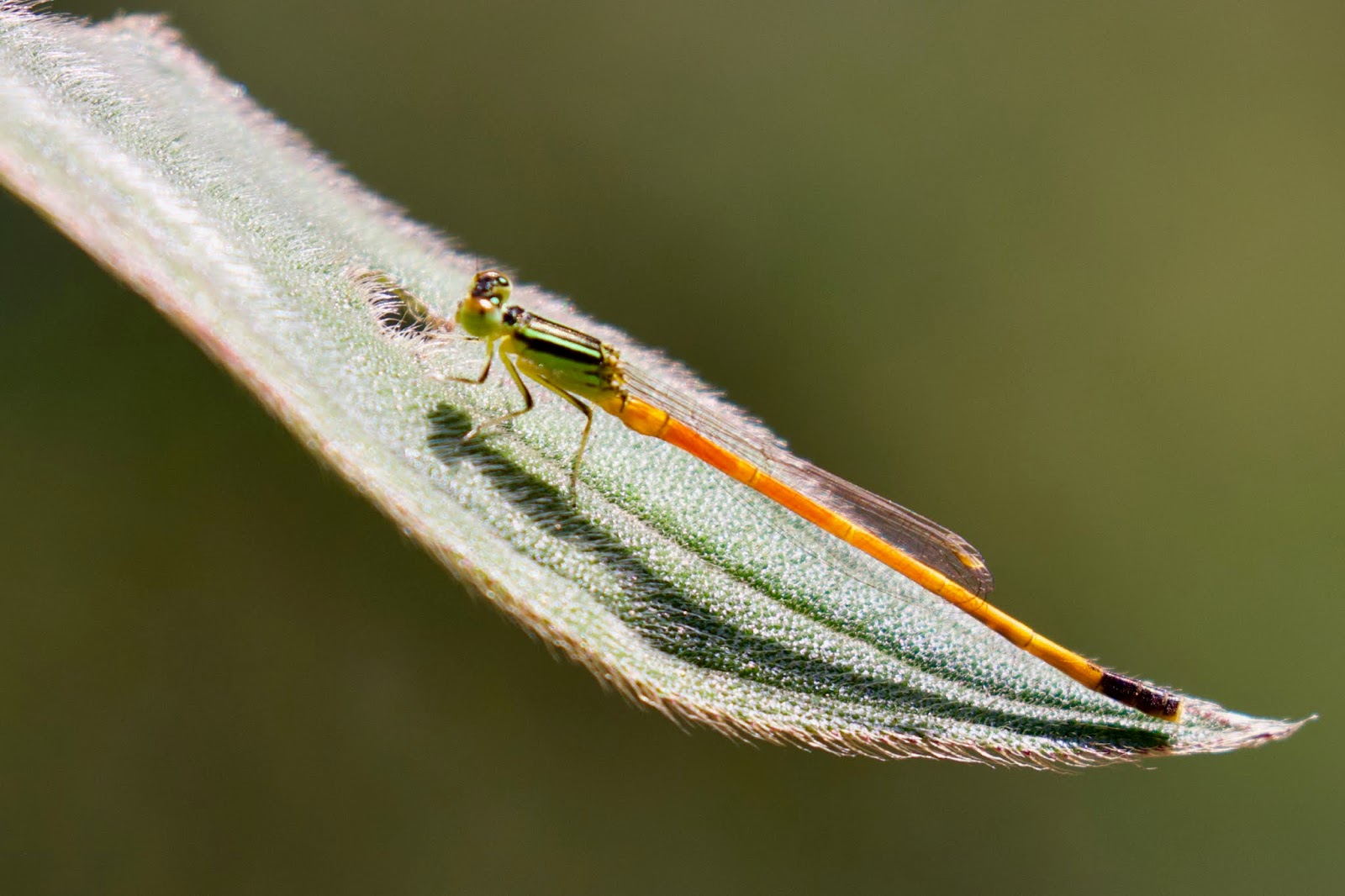
Ischnura rufostigma rufostigma
Selys 1876 (rufostigma group)
I. annandalei Laidlaw 1919; I. mildredae Fraser 1926; I. carpentieri Fraser (1946) Asahina (1970) placed I. carpentieri and I. annandalei in synonymy with I. mildredae and considered all to be a subspecies of I. rufostigma
Elevation 700 - 1600m
Abdomen Length 23-24mm

At first glance, it is very similar to I. aurora but the amount of blue in segment 8 varies. There are many variations of blue and even no blue. Vick 1986, worked on the I. rufostigma group because of the many noticeable variations of the abdominal segments 6-10 and what he considered distinct differences in male anal appendages. 
This one is from Godavari. Vick 1986, placed it in the carpentieri group with a blue mark on the 8th segment and stronger tubercles. Asahina (1991) later described these under the name I. rufostigma montana, because of the elevation where it was found - ie Godavari Nepal. The group remains confusing and without molecular work, the confusion will not be resolved. A 2016 paper from China attempted to sort out the I. rufostigma group and the biomorphic coloration found in the females. They found that the phenotypic variability in the expression of color was related to allele configuration and not different species.
Females in the photos show two color forms as per the taxon the pterostigma is bicolored. Mating was observed twice in June and September. They are found at the Kunda on the water and in the grasses. Seen from March through October.

Male
Mating

Ischnura rufostigma rufostigma
Selys 1876 (rufostigma group)
Elevation 700 - 1600m
Abdomen Length 23-24mm

This one is the sub-species found in Pokhara (it is different from the Godavari form above) found along the edge of Phewa Taal, Dipang, and Rupa Taal. It has no blue on the 8th segment. The bichromatic females can be found in red and the androchrome form of the male. They are found from March through the end of September. The I. rufostigma group is widely distributed and there are many differences within the group, but all are lumped under rufostigma. It has been divided into several subspecies but still, the amount of work on this one is inconclusive. Vick 1986 divided them into two groups one from Pokhara as I. rufostigma rufostigma and from Kathmandu (Vick) as I rufostigma carpentieri but then Asahina 1991 changed that to I.rufostigma montana and then just forma.

Male

Female

Ischnura nursei
(Morton, 1907)
Elevation 80m plains
Abdomen length 14mm

Its common name is Pixie Dartlet. The thorax is black on the dorsum and pale blue sides, and the abdomen is a mix of red and black with pale reddish anal appendages. It is found in grassy areas around lakes and wetlands in India. In Nepal, it is found at Jagadispur Lake near Lumbini. A paper on this sighting was published by Milan Aryal in 2019. The photo below is courtesy of Milan Aryal. A tiny but quite pretty species.

Male